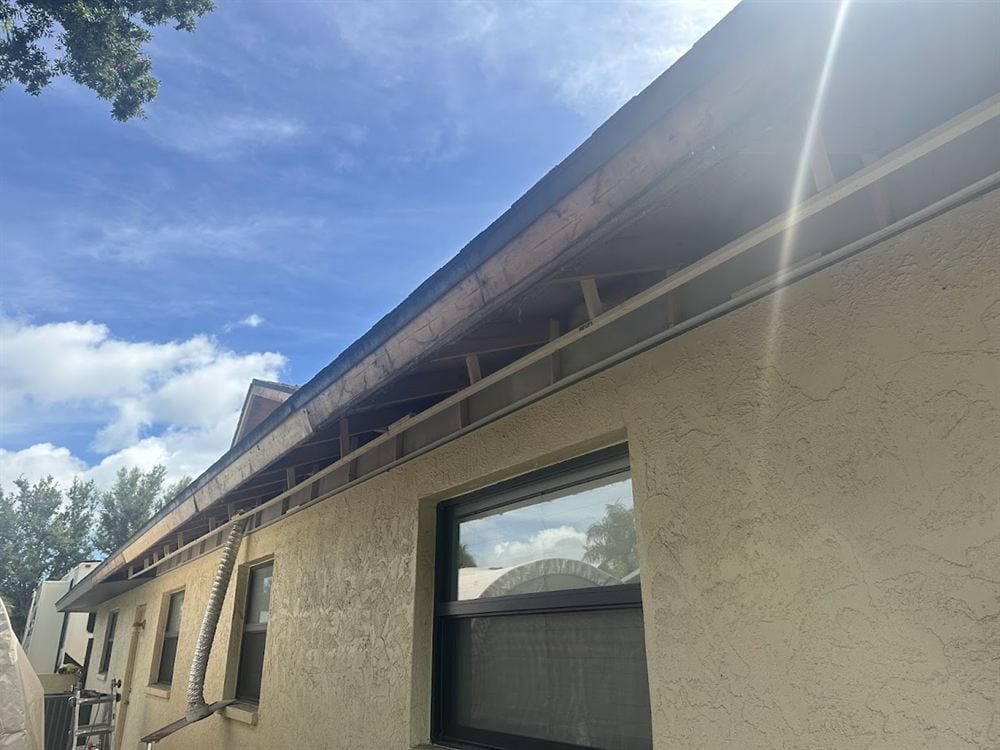
Salt Air and Your Roofline: What Sarasota & Bradenton Homeowners Miss
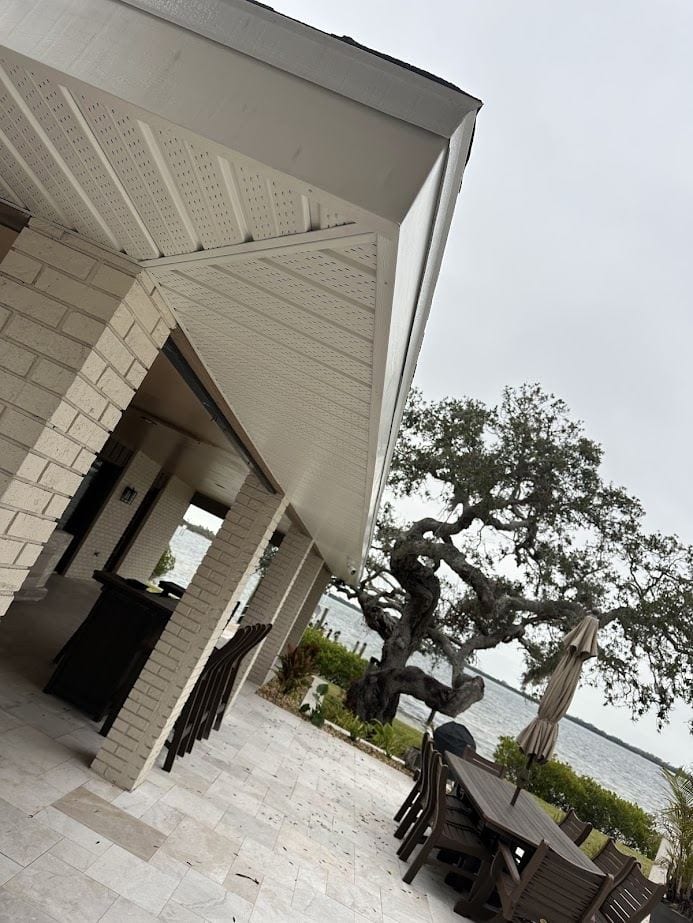
A Vexiva One job photo. Finished cream soffit above a waterfront patio with brick columns.
Most coastal homeowners are watching the wrong thing. You look up at the soffit panels, they still look fine, so you assume the roofline is fine. Meanwhile the fasteners holding those panels have been quietly giving up for years.
Salt doesn't need a beach view
Onshore breeze carries salt aerosol well inland. Homes in Bradenton, Palmetto and eastern Sarasota that are nowhere near the water still collect it. The worst place is exactly where nobody looks: the underside of the eave, where rain never reaches to rinse anything off. Salt deposits sit there, hold moisture out of the air, and keep the surface damp far longer than the rest of the house.
What actually fails first
In our experience the failure order on a coastal roofline is almost always the same, and the panels are near the end of it:
- Fasteners. Steel screws or nails driven into aluminum sit in a damp, salty environment, a textbook setup for galvanic corrosion between two dissimilar metals. The head rusts, the shank thins, and the panel starts to move in the wind.
- Cut edges and hems. Aluminum's protective oxide layer is thinnest where the panel was cut on site. That's where pitting starts, and pitting doesn't buff out.
- Gutter hangers and downspout straps. Same problem as the fasteners, with the added load of a full gutter after an afternoon storm.
- The fascia behind the wrap. An aluminum fascia wrap looks permanent. If water gets behind it through a failed fastener hole, it stays behind it.
The seasonal-home problem
A large share of the homes we see between Palmetto and Venice are empty for months at a time. A single panel works loose in a summer storm, the attic is suddenly open to wind-driven rain and wildlife, and nobody finds out until October. The repair that would have been one section in June is a much bigger job by then.
What to check twice a year
None of this needs a ladder. From the ground, with binoculars or a phone camera at full zoom:
- Chalky white powder on the underside of the eave. That's aluminum oxide, and it tells you the surface is being attacked.
- Rust streaks running down from individual fastener heads.
- Panel edges lifting, or a soffit panel that flexes visibly on a windy day.
- Gutter seams weeping, or hangers pulling away from the fascia.
- Vent perforations that look filled in. Clogged vents mean your attic stops breathing.
What we do differently on the coast
We use stainless fasteners on coastal jobs rather than the plated steel that ships with most panels. We rinse the underside of the eave before we close it up. And we photograph whatever we find behind the old material and send it to you, whether you're in Sarasota that week or in Ohio.
Want a look at your roofline?
Free inspection, written estimate within one business day, anywhere in our 16-county service area.